
Challenge Your Strategy with AI: A Practical Strategic Foresight Exercise for Leaders

Every strategy is built on assumptions.
Some are explicit.
Many are invisible.
We assume customers will continue behaving the same way. We assume competitors will react in predictable ways. We assume regulations will remain stable, technologies will evolve at a manageable pace, and our current capabilities will still be relevant in three years.
These assumptions quietly shape every strategic decision an organization makes.
The problem?
Very few leadership teams ever stop to examine whether those assumptions are still true.
As markets become increasingly uncertain—and as Artificial Intelligence gives organizations unprecedented access to information—the ability to challenge assumptions is becoming one of the most valuable leadership capabilities.
Why assumptions matter more than strategy
Organizations rarely fail because they lack information.
They fail because they continue making decisions based on outdated assumptions.
History is full of examples.
Companies that believed customers would never change.
Businesses that underestimated new technologies.
Leadership teams convinced that their competitive advantage would last forever.
By the time those assumptions are proven wrong, adapting often becomes far more expensive.
Strategic Foresight is not simply about predicting the future.
It is about continuously questioning the beliefs that shape decisions today.
A practical AI exercise you can use today
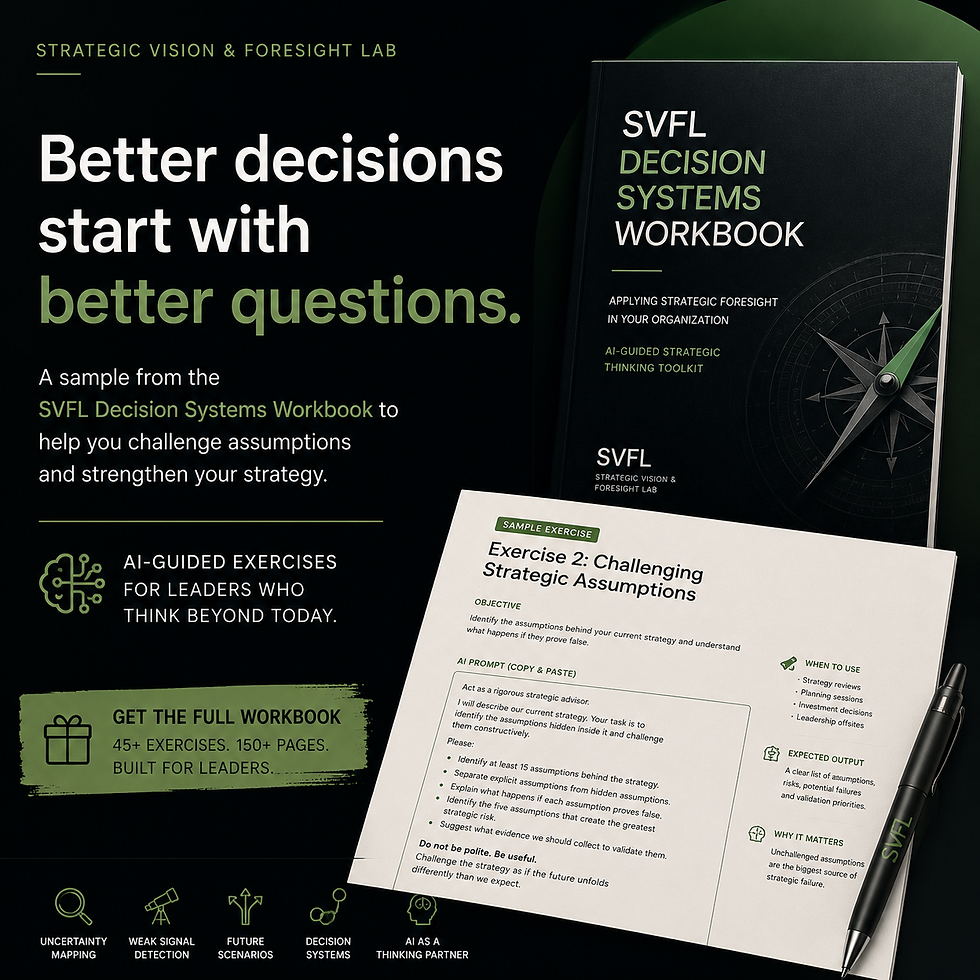
Below is one exercise taken from the SVFL Decision Systems Workbook.
You can copy and paste this directly into ChatGPT or any large language model.
Prompt:
"Challenge This Strategy
Act as a rigorous strategic advisor.
I will describe our current strategy. Your task is to identify the assumptions hidden inside it and challenge them constructively.
[Insert your strategy here]
Please:
Identify at least 15 assumptions behind the strategy.
Separate explicit assumptions from hidden assumptions.
Explain what happens if each assumption proves false.
Identify the five assumptions that create the greatest strategic risk.
Suggest what evidence we should collect to validate them.
Do not be polite. Be useful. Challenge the strategy as if the future unfolds differently than we expect."
Why this exercise works
Most strategic planning sessions focus on defending the current strategy.
This exercise does the opposite.
It forces leadership teams to expose hidden assumptions before the external environment does.
The objective isn't to prove your strategy wrong.
The objective is to make it more resilient.
Many organizations already use AI to summarize reports, write documents or automate repetitive work.
Far fewer use AI to improve strategic thinking.
This is where some of the greatest opportunities lie.
From AI assistant to strategic thinking partner
Artificial Intelligence should not replace executive judgment.
It should strengthen it.
Used correctly, AI becomes a thinking partner that helps leaders:
Challenge assumptions
Explore alternative futures
Identify blind spots
Stress-test strategic decisions
Improve organizational learning
Support more robust decision-making under uncertainty
The value is not in letting AI make decisions.
The value is in using AI to ask better questions before decisions are made.
Beyond prompts: building organizational decision systems
One prompt can improve one conversation.
But sustainable competitive advantage comes from embedding these practices into the organization itself.
At the Strategic Vision & Foresight Lab (SVFL), we believe the future of Strategic Foresight is not producing more reports or more scenarios.
It is operationalizing future thinking through better organizational decision systems.
That means integrating Strategic Foresight into governance, innovation, investment decisions, product development, portfolio management and executive decision-making.
Because the future doesn't change organizations.
Decision systems do.
The SVFL Decision Systems Workbook
This exercise is one of 45 executive exercises included in the SVFL Decision Systems Workbook.
Designed for executives, consultants, innovation leaders and strategy teams, the workbook contains more than 150 pages of AI-guided exercises that help organizations:
Challenge strategic assumptions
Detect weak signals
Map uncertainty
Explore future scenarios
Improve strategic decision-making
Operationalize Strategic Foresight
Build future-ready leadership capabilities
Rather than teaching Strategic Foresight as theory, the workbook provides practical exercises that can be immediately applied inside organizations.
If you're looking to move beyond trend reports and begin embedding future thinking into everyday strategic decisions, the workbook offers a practical starting point.
👉 Explore the SVFL Decision Systems Workbook and start building a future-ready decision system today.


